Chance's Choice Awards 2025
Welcome everyone to the second annual Chance's Choice Awards! Today, I am so pleased to be presenting this prestigious and personal awards list! The composition of this awards list includes video games, albums, and books that brought me joy and meaning throughout this past year. Unlike other awards shows, the selections are not bound to the year in question, but are found on this list due to their impact to my life during the year in question: 2025. I am, again, making no attempt to concern myself with quantifiable personal data and I am not considering the broader impact of the selected media on today's society.
This is a personal list.
A personal list that was created during one place and time, therefore subject to non-recorded changes as my memory evolves of this passing year. But with all of the qualifiers out of the way, I humbly present the Chance's Choice Awards 2025.
Straight Line is a Lie by The Beths
The New Zealander indie rock band, The Beths, is known for poppier tracks like "Expert in a Dying Field" and "Future Me Hates Me." Both of those tracks are fantastic, but I found their latest album, Straight Line is a Lie, to exceed their prior work though its strong lyricism and moodier (and therefore more nuanced) undertones. Three songs stand out for myself as highlights. The energetic guitar-heavy "No Joy" speaks to the Elizabeth Stokes' experience of anhedonia and how crushing it can be. She shares how she "Wanted to cry but I couldn’t / Tear ducts full, I felt you pulling at them / But it didn’t happen." The album's opener, "Straight Line is a Lie" laments the challenge of expectation during recovery. During the chorus, Stokes confesses that "I thought I was getting better / But I'm back to where I started" – continuing on the conclude that the "the straight line was a lie." Then, my favourite track is is "Metal," which channels those 90s jangle pop sounds that I find so much joy in. But underneath those shimmering guitar riffs, there is a lyricism that speaks to Stokes' health challenges with an autoimmune disorder. The entire song is a chronicle of Stokes' discovery of what it means to exist in a body, from learning that "you need the metal in your blood to keep you alive" to accepting that our body is "a collaboration of bacteria, carbon and light." Given my own reckoning with health over the past few years, with a particularly difficult time at the beginning of the year, I find myself feeling so much comfort listening to this album.
The Burning Earth: A History by Sunil Amrith
Sunil Amrith's The Burning Earth: A History is a historical examination of human civilization's futile attempt to disentangle ourselves from natural world and how we have found ourselves in the midst of a planetary ecological crisis. At the heart of Amrith's perspective is the well-defended belief that humans (often of the Global North – but not exclusively) have sought freedom from environmental constraint for millennia. Whether Amrith is discussing early agricultural cultivation, synthetic fertilizers, suburban sprawl, or fossil fuel extraction, his book is a truly sweeping history, but though it covers a lot, it never loses the bigger picture. Personally, I find the chief achievement of Sunil Amrith's writing is how global it is. Often environmental histories, in my experience, are dominated by the perspectives of the "western world", but the author gives ample space stories from Chile, Nigeria, India, and Indonesia to be shared.
No Man’s Sky
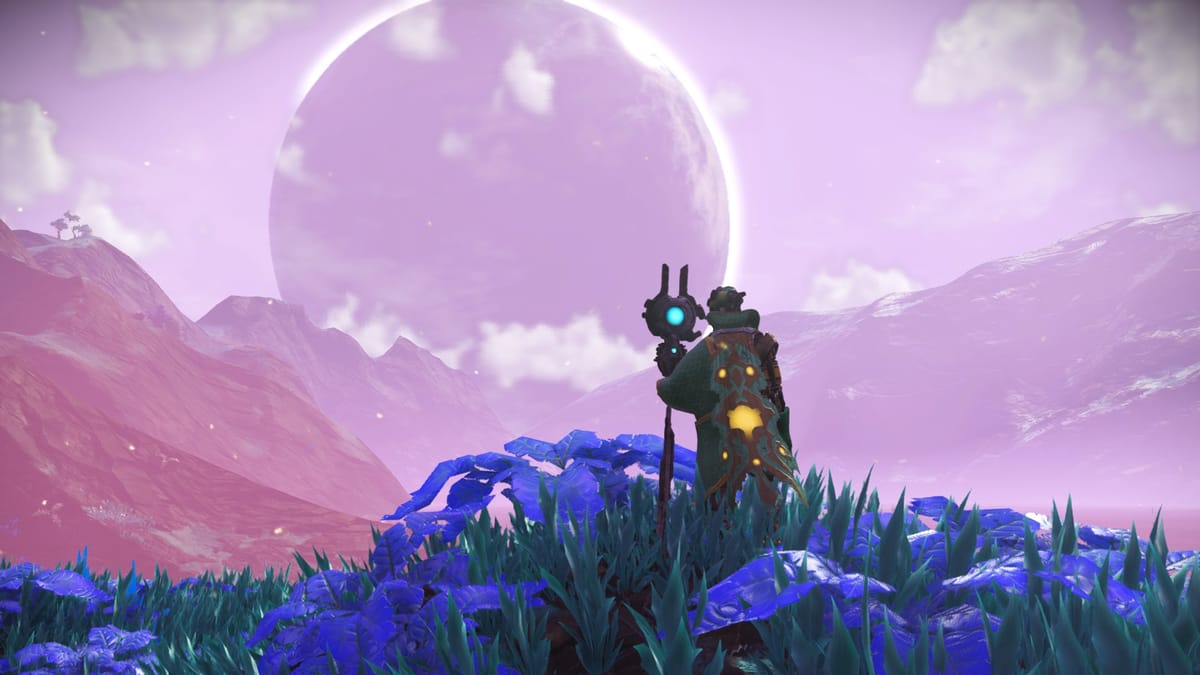
Despite being initially released (disastrously I might add) back in 2016, this year has proved to be wonderful for No Man's Sky's continued post-launch development. With the Worlds II and Voyagers updates, I found so much joy in returning to this game (even wrote a blog post on it). For those outside the know, No Man's Sky is a space exploration game grounded in procedural generation. The player begins stranded on a planet with a downed starship off in alien landscapes' horizon. Once the starship is repaired, the player is unleashed upon the galaxy to document strange lifeforms, harvest resources, build bases, and explore freely. Naturally, there is a few questlines, but the brilliance of the game is the sandbox – which is unapologetically galactic in scale with no limits to exploration. Playgrounds like this work wonders for my imagination, and I really enjoyed exploring new uncharted planets with horrendously extreme storms and fantastical critters.
Is A River Alive? by Robert Macfarlane
When I read Robert Macfarlane's Underland: A Deep Time Journey during the early months of the pandemic, I was enamored with his naturalistic prose, compassionate storytelling, and frictionless weaving between subject matter. This time, for claustrophobes like myself, Robert Macfarlane is no longer delving into subterranean worlds, but riverine ones instead. Central to Is A River Alive? is the very question itself – something being discusses in in legislative assemblies, courtrooms, and academic circles around the world. To paddle into this debate, Macfarlane details three rivers systems: (1) the Los Cedros in Ecuador, (2) Adyar River in India, and (3) Mutehekau Shipu in Canada. Each section of the book is a love letter to the river itself, but also gives attention to existential ecological challenges facing these rivers (and therefore ourselves) - ranging from the disruption of ancient migratory routes for freshwater fish through the construction of hydroelectric dams to catastrophic levels of industrial pollutants despoiling aquatic life. Then there are the profiles of the folks who join him in his expeditions. Each person is given so much life through his empathetic and mindful characterization, and that allows the reader to appreciate the stewards who keep watch over and protect these troubled waters. On a personal note, as someone who has started biking quite regularly this year, I often find myself riding along our city's Bow River Pathway system and I am blessed to accompany the Bow's fast-moving glacial waters. This book continued to remind me of the vitality behind these wonderful flows and I am grateful I was able to meet this writer back in spring at our city's Central Library for a book talk.
Balatro
Let me start out by issuing a warning: this game is dangerous. Steam reviews compare this Poker-themed roguelike deckbuilding game to crack cocaine and though I have never partaken in dabbling with that illicit substance, I can attest that Balatro is truly addictive. But what exactly is it? Well, in Balatro, players typically start with a regular playing card deck (sometimes with a modifier - either positive and/or negative) and must score a certain number points each round to progress. Over time, the difficulty will scale higher, but as a player, you will be able to use earned money to purchase different items in the shop to improve the odds of meeting ante. Joker cards have unique abilities that can transform your game entirely. Tarot cards grant enhancements to your playing cards. Planet cards will upgrade associated poker hands. And Spectral cards, though rare, provide an immense boon (but often have a negative cost that burdens you). There are also expensive vouchers that provide a bonus throughout the entire game. As a player, you will come to recognize synergies and build your deck towards maximizing points. And this is where the replayability comes from. Even more stunning than the game's very affordable price (just under $20), it was created by a solo developer. Another indie dev win!
Fire Weather: The Making of a Beast by John Vaillant
As someone who grew up in Grande Prairie, I have always considered places like Prince George, Fort St. John, Grande Cache, and of course, Fort MacMurray, too have a shared identity of sorts. All of these settlements are "northern" or "remote" (relative to a vast majority of Canadians), were built around the intensive extraction of natural resources, and full of (often transient) hard-workers looking to make a shit ton of money to support themselves and their families. Though I have moved from Grande Prairie over a decade ago to a large urban centre, I still have an admiration for the gumption of these communities and I feel kinship when I stumble upon folks who grew up in these cities – though political affiliation is another issue entirely.
When I was reading John Vaillant's Fire Weather: The Making of a Beast, I felt this love and understanding with every word he wrote. The Canadian author carries this curiosity and empathy for the folks of Fort MacMurray and their experience with the 2016 Fort MacMurray wildfire; including firefighters, evacuees, city officials, and a reckless man that attempted to save his home with a fucking garden hose (only to sneak back into the city against government orders to check on his belongings). As he profiles these individual stories, his book also brings them into a wider panoramic (and epic) tale of the battle waged by Fort MacMurray as it faced this unprecedented disaster. Of course, Vaillant also weaves in a broad range of intersecting and deeply-interesting concepts, like bitumen processing and its place within the economic development of the fossil fuel industry, the everyday household threats that allowed residential neighbourhoods to immolate (hint: many residents love outdoor recreation vehicles), and the meteorological nature of wildfires themselves (which can create legendary fire tornados). By the last page, I had come to understand why Fire Weather: The Making of a Beast won so many book awards.
Inscryption
Look, adding another deckbuilding game to this list might be overkill, but stay with me. Though my dopamine-deficient brain gravitates to Balatro, Taylor convinced me to try indie developer Daniel Mullins' 2021 Inscryption. On the surface, it is a creepy roguelike deckbuilder. From the get-go, you are held captive by a mysterious stranger in his cabin and must beat his deckbuilding card game to escape with your life (though you might lose a few teeth along the way). If you fail, the cycle resets. Now this is where it gets tricky, because if I continue to discuss the narrative beyond that point, I would spoil it and you do not deserve that. But I will say that beyond the narrative, whilst Inscryption has an engaging gameplay loop, it also acts as a larger conversation of gaming and how we engage with games as players.
Getting Killed by Geese
The opening track of Geese' 2025 art rock album, Getting Killed, begins with Cameron Winter frenetically screaming "There’s a bomb in my car!" Yeah, it is one of those albums and I won't apologize for its more chaotic moments, because this is rock music done right. Songs like "100 Horses" and "Bow Down" are so fucking catchy in their own right, but the last two tracks of the album are my personal highlights. "Taxes" begins relatively low-key, but at the midway point of this track, there is an abrupt and intoxicatingly uplifting shift in tone as Winter's defiantly proclaims that if they want him to pay his taxes, that they better bring a crucifix and nail him down. Simply iconic. And then there is my personal song of the year: "Long Island City Here I Come." This six-minute rock odyssey is riddled with religious themes, near-manic lyricism, and splendid chaotic instrumentation. And holy shit, the fucking crescendo being built throughout this song is unreal. In any regard, I am not done with this album. My fondness for it grows with more attention.
Hypochondria by Will Rees
On the surface, this is considered a "philosophical essay," but it is also part-memoir and history. This genre-bending book covers lots of ground in just over 200 pages, from chronicling Will Rees' experience with hypochondria, the cultural depiction of the malady, the medical history of diagnosis, and the philosophical understanding of health. A reader will hear about Seinfeld's comical depiction of hypochondria, the diagnosis of health anxiety itself (which has undergone transition over the 20th century), and the often gendered understanding of hypochondria in men (amongst other things certainly). As someone who has struggled with episodes of health anxiety for as long as I can remember, this book made feel uncomfortable. At times, I had to close the book and take a break, largely due to my own recognition in myself. Throughout the book, Will Rees regals the reader with the written work of famed hypochondriacs, which gives access to the inner worlds of long-time sufferers – like Scottish writer, James Boswell. This was a troubled gentleman who chronicled much of his life through the diary entries and was fanatical about planning for the future. What Rees says regarding Boswell's life might as well be a goddam personal attack on my own neurosis. "His fear of moral and physical collapse, but also the obsession with discipline and order with which he tried to combat it, this strange convergence of self-cure and symptom. Read cumulatively, this carousel of relapses and resolutions forms a tragicomic record of a self that is constantly getting away from itself." It was passages like that, which cut deep and hurt immensely, that gave me pause and provided me with an opportunity to reflect on my own demons. I will leave you all with a quote that resonated with me and exposed my own arrogance, something I imagine is shared with Boswell: "Hypochondria is the dream of perfect knowledge. What haunts the hypochondriac is everything that remains out of sight, which refuses to the remain out of mind."
viagr aboys - Viagra Boys
In 2022's Cave World, the Swedish art punk band, Viagra Boys, explored the intersection of pandemic-era far-right conspiracism and human de-evolution in iconic tracks like "Troglodyte" and "Return to Monke." It was a raucous album that never took itself too seriously, yet still had something to say – even if that something to say was double-dipped in terminally-online sarcasm. For their almost self-titled album, viagr aboys, lead singer Sebastian Murphy and the rest of Viagra Boys have gravitated towards an arguably less-focused, but nonetheless entertaining album. Rather than following the mad ramblings of paranoid anti-vaxxers, there is an diverse range of odd voices finding presence on this album. In "Bog Body", the listener is accused of being "consumed by jealousy" for a swamp woman's "darkened skin and her dainty nose." For "Uno II", we hear the internal thoughts of a domestic dog undergoing a veterinarian's surgery and ponders where their teeth are being taken to. But my favourite track on the album (and the one that resonated with me the most) is "Pyramid of Health." The narrator chronicles his descent into woo-woo alternative health after a endoscopy reveals his "stomach's merely fried from eating cigarettes for breakfast." To avoid death, he is advised to follow seven easy steps. From eating cactuses for breakfast to drinking liquor from a tree, the narrator is called upon to save himself by giving in to spiritual rituals that will shield him from sickness. It parallels experiences I often have when trying to traverse online spaces for information on health; only to face an onslaught of hypermasculine wellness influencers praising the latest superfoods, quick fix supplements, and pseudo-scientific life hacks. Like seriously, shut the fuck up about your keto diet and daily cold showers.
Conceptually, I experienced viagr aboys as an open question regarding the difficulty of achieving wellness and what it means to earnestly experience that wellness. As a person with attention-deficient hyperactivity disorder, and as previously stated, health anxiety, I have carried a feeling that I must strive towards self-optimization above all else, even when I understand that ambition to be foolish. Whether it comes down to meal planning my way to the perfect plant-based diet, operating a streamlined life administrative system, or maintaining an unwavering commitment to a regimented sleep routine, I had unintentionally bought into the belief that any deficiency could be overcome through the lens of a mechanic tinkering with a machine. And that belief is utter bullshit, we are not machines. Rather, we are "made of meat" and we forget that organic beings like us will break down. Instead of fantasizing about self-optimization lately, I have been working to capture the spirit of the album's gorgeous closing track: "River King." To find beauty and brilliance in the mundane, even if that means spending fleeting time with a loved ones "playing video games all day" and enjoying Chinese food that "tastes like sour meat." It is difficult to find contentment with life's natural flow and simply give in to the impermanence of it all, but I try my best and it does get easier when I give to the flow of how my brain works (which is by channeling my restlessness in the right direction).